












What is Propecia for hair loss?
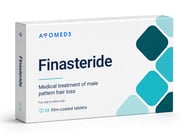
Propecia is a prescription-only hair loss treatment for men containing finasteride 1 mg. It targets the hormonal cause of male pattern hair loss by lowering DHT levels in the scalp. This helps prevent further thinning and promotes healthier, stronger hair.
Because Propecia for hair loss treats the underlying hormonal mechanism, it is considered one of the most effective long-term therapies for male pattern baldness.
Active ingredient and medical use of finasteride
Propecia contains finasteride 1 mg as its active ingredient. Finasteride belongs to a class of medicines known as 5-alpha-reductase inhibitors. It works by blocking the enzyme 5-alpha reductase, which is responsible for converting testosterone into dihydrotestosterone (DHT) — the androgen that is the primary driver of androgenetic alopecia, commonly known as male pattern hair loss. By reducing DHT levels in the scalp by approximately 60%, finasteride interrupts the hormonal process that causes hair follicles to miniaturise and eventually stop producing hair. [1]
Finasteride 1 mg is licensed in the UK for the treatment of male pattern hair loss (androgenetic alopecia) in adult men. It is not indicated for use in women or children. A separate formulation — finasteride 5 mg — is licensed treat benign prostatic hyperplasia (enlarged prostate) under the brand name Proscar, but Propecia at the 1 mg dose is indicated specifically and exclusively as hair treatment for men. [2]
How Propecia treats male pattern hair loss
Male pattern hair loss follows a well-established hormonal pathway. In genetically predisposed men, hair follicles on the scalp are sensitive to DHT — a potent androgen derived from testosterone. Prolonged exposure to DHT causes these follicles to progressively shrink, producing finer and shorter hairs with each growth cycle, until the follicle becomes dormant and visible thinning or baldness results.
Propecia addresses this at the root cause rather than at the surface. By reducing levels of DHT in the scalp, finasteride can help slow further hair loss and may increase hair growth in some men with male pattern baldness. Results are gradual: most men notice a reduction in shedding within the first three months, with visible improvement typically apparent after six to twelve months of consistent use. Propecia must be taken daily and continuously — stopping treatment reverses the effect, and hair lost during the period of non-treatment is not recovered.
Propecia in focus
|
Dosage |
One Propecia tablet (1 mg) once daily |
|
Dosing |
At the same time each day |
|
Onset of action |
Improvements usually appear after 3–6 months Full results by 12 months |
|
Condition |
Works only when taken continuously |
|
Target population |
Men with male pattern hair loss. Not suitable for women |
|
Taking with food |
With or without food |
How does Propecia work?
Male pattern hair loss is driven by DHT (dihydrotestosterone), a derivative of testosterone that causes hair follicles to shrink over time.
Propecia (finasteride 1 mg) works by blocking the enzyme 5-alpha-reductase, which converts testosterone into DHT.
The role of DHT in hair loss
Lower DHT levels result in the following benefits of Propecia:
- reduced shedding within 3 months;
- visible thickening within 6 months;
- healthier, stronger hair;
- long-term stabilisation of hair loss
How finasteride reduces DHT levels in the scalp
Testosterone is converted into dihydrotestosterone (DHT) by an enzyme called 5-alpha-reductase, which is active in the scalp, prostate, and liver. DHT binds to androgen receptors in hair follicles with roughly five times the potency of testosterone itself — making it the primary hormonal driver of follicle miniaturisation in genetically susceptible men. [4] Finasteride works by competitively inhibiting the type II isoform of this enzyme, blocking the conversion reaction and reducing serum DHT levels by approximately 65–70% and scalp DHT by around 60% within 24 hours of the first dose. [5] It does not block androgen receptors directly and does not significantly suppress circulating testosterone, which means the mechanism is targeted rather than broadly hormonal — effective where it needs to be, without systemic androgen suppression.
How effective Propecia is for hair loss treatment
Propecia is a clinically proven and effective treatment for male pattern baldness if used with a proper attitude. The sustained reduction in local DHT concentration allows androgen-sensitive follicles to recover their normal growth cycle over successive months, which is why the clinical response to Propecia is gradual rather than immediate.
Clinical evidence and success rates
The most cited figure comes from the pivotal two-year Phase III trial by Kaufman et al. (1998), which found that 83% of men taking finasteride 1 mg maintained or increased their hair count, compared to 28% on placebo. Visible hair regrowth was observed in approximately 66% of men. [3]
A five-year follow-up of the same population extended this finding: among men who continued treatment, 90% maintained or improved their hair count at year five, with visible hair regrowth observed in approximately 65% of men. [6] The 90% figure is therefore clinically valid — but specifically for men who take finasteride consistently over five years, not as a general headline figure for any duration of use.
Longer-term evidence reinforces the case for continuous treatment. A 10-year open-label study found that men who remained on finasteride 1 mg maintained significant improvements in hair count and scalp coverage relative to baseline, with a mean increase of 91 hairs per cm² versus untreated controls. [7] Importantly, the studies also confirm the reversal effect: men who discontinued treatment lost the benefit within 12 months, returning to the hair loss trajectory they would have followed without treatment.
How long Propecia takes to work
Propecia is not a quick fix, and setting realistic expectations from the outset makes a meaningful difference to how men experience treatment. Finasteride works by interrupting a hormonal process that has been operating for years — and reversing or stabilising that process takes time. Most men need to commit to at least six to twelve months before forming any judgement about whether the treatment is working for them.
Typical treatment timeline and expected results
The earliest sign that finasteride is working is often a reduction in shedding — many men notice less hair on the pillow or in the shower within the first two to three months. This can briefly feel counterintuitive, as an initial temporary increase in shedding is sometimes reported in the first few weeks as the hair growth cycle resets; this is normal and settles on its own.
Visible improvement in hair density typically becomes apparent between six and twelve months of daily use. Healthy hair growth continues to accumulate beyond the first year: hair count and scalp coverage in long-term studies were still improving at year two and, in some men, beyond.
A realistic timeline looks broadly like this:
|
Timeframe |
What to expect |
|---|---|
|
Weeks 1–8 |
Possible temporary increase in shedding; no visible regrowth yet |
|
Months 2–3 |
Shedding typically stabilises and begins to reduce |
|
Months 6–12 |
First signs of visible improvement in hair density for most men |
|
Year 2 and beyond |
Continued improvement; maximum benefit usually reached around year 2 |
|
5 years+ |
90% of men maintain or improve hair count with consistent use |
What happens if treatment is stopped
The benefits of Propecia are contingent on continuous use. Finasteride does not alter the underlying genetic predisposition to androgenetic alopecia — it suppresses the DHT-driven process that causes it. When treatment stops, DHT levels return to their pre-treatment baseline within approximately two weeks, and further hair loss process resumes. [2]
In clinical trials, men who discontinued finasteride lost the hair they had gained or maintained within twelve months of stopping, returning to approximately the same point they would have reached had they never taken treatment. [6] There is no evidence that stopping finasteride accelerates hair loss beyond the natural rate — it simply removes the protective effect.
This means Propecia is best understood as a long-term management strategy rather than a course of treatment with a defined endpoint. Men who respond well and wish to maintain their results need to continue taking it indefinitely, with periodic review by a prescriber.
Who can use Propecia for hair loss?
Propecia is most likely to benefit adult men with early to moderate hair loss (androgenetic alopecia), particularly those experiencing gradual thinning hair around the crown or mid-scalp. Because finasteride works by reducing levels of dihydrotestosterone (DHT) in the scalp, treatment is most effective while hair follicles are still active rather than in areas that have been completely bald for a long time.
Propecia is not indicated for use by women or children.
If your main concern is a receding hairline, it is important to have realistic expectations, as the evidence for finasteride is stronger for hair loss affecting the vertex and mid-scalp than for bitemporal recession.
Who is Propecia not suitable for?
Propecia is not indicated for:
- women (especially pregnant women)
- men with certain prostate conditions
- men planning fatherhood soon (consult doctor)
- those allergic to finasteride or tablet ingredients
- men with significant liver disease — medical evaluation is recommended before starting treatment
Finasteride can lower prostate-specific antigen (PSA) levels, so tell your doctor that you take Propecia if you have a PSA test or are being assessed for prostate cancer.
How to take Propecia?
Standard dose: One Propecia tablet (1 mg) daily
How to take:
- Swallow whole with water
- Can be taken with or without food
- Take at the same time each day
- Do not double the dose if you forget a tablet
Because Propecia works gradually, consistent daily use is essential. Stopping treatment will reverse the benefits of Propecia within several months.
Propecia side effects
Common Propecia side effects reported:
- decreased libido
- difficulty achieving an erection
- lower ejaculate volume
These sexual side effects of Propecia are usually mild and reversible, but persistent symptoms should be reviewed by a clinician.
Less common side effects of Propecia:
- breast tenderness
- testicular discomfort
- mood changes
- temporary reduction in sperm quality (usually reversible after stopping)
A small number of men report mood alterations, including low mood or anxiety. Inform your doctor immediately if you notice any psychological changes.
Rare side effects of Propecia:
- persistent sexual side effects (decreased libido, erectile dysfunction)
- allergic reactions
- breast tissue changes (requires immediate review)
Most men tolerate Propecia without significant issues.
Taking Propecia with other medications
Propecia generally has few interactions, but some medicines require caution:
- Other hormone-related treatments (e.g., testosterone therapy)
- Some antidepressants (possible impact on libido or mood)
- Alpha-blockers used for prostate symptoms or high blood pressure
- Medicines that may affect liver function, as finasteride is metabolised in the liver
- Any medication affecting hormonal balance
Special notes:
- Propecia does not interact with alcohol, though moderation is recommended for overall health.
- Do not combine Propecia with finasteride 5 mg (for enlarged prostate).
If you are unsure whether your current medicines are compatible, seek medical advice before taking Propecia tablets.
Propecia vs Finasteride tablets – what is the difference?
Propecia is the original brand-name version made by MSD. Since 2021, it has been owned by Organon, a subsidiary of MSD.
Finasteride is the generic version, containing the same active ingredient, the same 1 mg dose, and the same effectiveness. It is manufactured by various pharmaceutical companies
The main difference is the cost of Propecia: generic Finasteride is usually cheaper.
Some men prefer Propecia pills for brand reassurance; others choose finasteride to reduce expenses.
How to buy Propecia safely in the UK?
As Propecia is a prescription-only medicine in the UK, it may be supplied following a clinical assessment and, where appropriate, a private prescription. This applies to purchases in traditional pharmacies and to buying Propecia online.
Buy Propecia online safely
- Complete an online consultation;
- Order Propecia online in the UK from a reputable provider
- Enjoy fast and discreet delivery.
Offers that sell Propecia online without a prescription should be avoided.
Money matters:
The Propecia price varies depending on the supplier and the size of the pack.
Generic Propecia can be considered if you would like to save on the Propecia cost.

-
[1] Kaufman KD, et al. Finasteride in the treatment of men with androgenetic alopecia. J Am Acad Dermatol. 1998;39(4):578–589. doi.org/10.1016/s0190-9622(98)70007-6
[2] Electronic Medicines Compendium (EMC) — Propecia 1 mg film-coated tablets (finasteride), Summary of Product Characteristics. https://www.medicines.org.uk/emc/product/2194/smpc#gref
[3] Leyden J, et al. Finasteride in the treatment of men with frontal male pattern hair loss. J Am Acad Dermatol. 1999;40(6):930–937. https://www.jaad.org/article/S0190-9622(99)70081-2/abstract
[4] Imperato-McGinley J, et al. Steroid 5alpha-reductase deficiency in man. Science. 1974;186(4170):1213–1215. doi.org/10.1126/science.186.4170.1213
[5] Drake L, et al. The effects of finasteride on scalp skin and serum androgen levels. J Am Acad Dermatol. 1999;41(4):550–554. doi.org/10.1016/s0190-9622(99)70007-0
[6] Finasteride Male Pattern Hair Loss Study Group. Long-term (5-year) multinational experience with finasteride 1 mg in the treatment of men with androgenetic alopecia. Eur J Dermatol. 2002;12(1):38-49. https://pubmed.ncbi.nlm.nih.gov/11809594/
[7] Rossi A, et al. Comparitive effectiveness of finasteride vs. serenoa repens in male androgenetic alopecia: a two-year study. Int J Immunopathol Pharmacol. 2012;25(4):1167–1173. doi.org/10.1177/039463201202500435


