


What causes hair loss in men? Genetics, hormones, stress, diet and a range of health conditions can all play a part. Here's a clear look at the main reasons hair thins or falls out, and when it's worth seeing a doctor.
Most men will notice some change in their hair over a lifetime, and for the majority, it isn't a sign of anything wrong.
Hair naturally cycles through growth and shedding, and it's normal to lose hair every day. Hair loss can also point to a specific cause worth understanding, though, whether that's an inherited pattern, a temporary trigger like stress or illness, or an underlying health condition.
This article covers what hair loss is, the main reasons for hair loss in men, the everyday factors that can make it worse, the common patterns it follows, and when to get medical advice.
What is hair loss?
Hair loss occurs when normal hair growth is disrupted, leading to increased shedding, reduced hair density or progressive thinning. Understanding the normal hair-growth cycle helps explain why this happens.
Why hair falls out
Each hair on your scalp runs through a repeating cycle. It grows actively for a few years (the anagen phase), briefly regresses (catagen), then rests before being shed (telogen), after which a new hair starts growing in its place [1].
At any given moment most of your follicles are growing while a smaller share are resting or shedding, so a steady, low-level loss is just the cycle turning over. This is part of having healthy hair, not a sign of a problem.
Because each follicle runs on its own timing, you shed a bit every day without noticing. Losing between 50 and 100 hairs a day is normal [2]. Problems can arise when too many follicles enter the shedding phase at once, or when the growth phase becomes progressively shorter and follicles produce finer, shorter hairs.
When hair loss becomes a problem
Normal daily shedding generally does not cause noticeable thinning because lost hairs are replaced as part of the normal hair cycle. Hair loss becomes noticeable when that balance tips: either more hairs enter the shedding phase than usual, or new growth doesn't keep pace [3].
A useful sign is a clear change from your normal. That might be more hair than usual on the pillow or in the shower drain, a widening part, a receding hairline, thinning hair across the top, or distinct bald patches.
Some of these are permanent patterns, like male pattern baldness, while others are temporary and reverse once the trigger passes. The sections below work through what drives each.
Main causes of hair loss in men

Hair loss causes in men are varied. Some are down to genetics and hormones, some to short-term triggers, and some to underlying medical conditions. Often more than one is at play, and identifying the type of hair loss is the first step to knowing what, if anything, to do about it.
Genetics and hormones
The single most common type of hair loss in men is androgenetic alopecia, better known as male pattern baldness. It's driven by a mix of genes and hormones. A form of testosterone called dihydrotestosterone (DHT) acts on sensitive follicles on the scalp [4]. Over successive growth cycles, affected hairs become shorter and finer, leading to increasingly visible thinning.
Genetic susceptibility plays a major role in how scalp follicles respond to androgens such as DHT, which is why male pattern hair loss commonly has a family history. It also tends to follow a predictable pattern rather than causing random thinning, and usually progresses slowly, over years to decades [5].
Nutrient deficiency and diet
Diet plays a supporting role in hair health, and certain nutritional deficiencies have been linked to hair loss, though the evidence is mixed (and much of it comes from studies in women). Iron is the most studied: low iron stores (measured as ferritin) may be associated with hair shedding, but reviews have found the evidence insufficient to say deficiency reliably causes hair loss on its own, or that supplements help in the absence of anaemia [6]. Deficiencies in vitamin D and zinc have also been associated with hair loss in some studies, again inconsistently [7].
The practical takeaway is modest: a healthy diet supports normal hair growth, and a genuine, diagnosed deficiency is worth correcting, but supplements aren't a proven fix for hair loss if your levels are normal. Poor nutrition is more likely to affect your hair when it's severe or prolonged, as covered under crash dieting below.
Stress and psychological strain
A significant physical or emotional shock can push a large number of follicles into the shedding phase at once, causing a diffuse hair loss called telogen effluvium. The trigger might be a serious illness, surgery, a bereavement, or another major life stress.
The shedding is usually delayed, appearing around two to three months after the event, which is why people often don't connect the two. The reassuring part is that it is usually self-limiting: once the trigger has passed, shedding gradually settles over several months and hair growth usually recovers [8].
Medicines and medical treatments
Certain medications, including some anticoagulants, retinoids and other drugs, can cause hair loss by affecting the hair cycle. When they trigger telogen effluvium, shedding often becomes noticeable several weeks to months after the medication is started.
Chemotherapy works differently, causing a more rapid and extensive loss (anagen effluvium) within days to weeks, because it targets the fast-dividing cells in the hair matrix [9]. Cancer treatment is one of the better-known causes of temporary hair loss.
In most cases, drug-induced hair loss reverses once the treatment stops. Never stop a prescribed medicine because of hair loss without speaking to your doctor first.
Thyroid disorders
Thyroid problems affect hair, too. Both an underactive thyroid (hypothyroidism) and an overactive one (hyperthyroidism) can cause widespread hair shedding [10]. Thyroid hormones help regulate the growth, differentiation and metabolism of many cells, including those in the hair follicle, so these hormonal changes can leave hair growth disrupted. Thyroid-related hair loss usually improves once the underlying disorder is diagnosed and treated.
Autoimmune conditions
Alopecia areata is one of several autoimmune diseases that can affect hair. In it, the immune system mistakenly attacks the hair follicles, causing sudden hair loss [11]. It typically produces small, coin-sized round patches on the scalp, though it can affect the beard, eyebrows, eyelashes or other areas, and in some cases becomes more extensive.
It's relatively common, with an estimated lifetime risk of around 2%, and it affects men and women equally. The course is unpredictable: hair often regrows on its own, but further episodes are common [12].
Scalp conditions
Some scalp disorders can contribute to hair shedding or breakage. Tinea capitis, a fungal infection, can cause patchy hair loss alongside scaling and inflammation [13, 14]. Other inflammatory scalp conditions may also affect hair growth or increase shedding when the scalp is significantly inflamed.
Because these conditions are treatable, and because an inflamed or scaly scalp can point to something that needs specific treatment, they're worth getting checked rather than self-managing.
Everyday factors that can worsen hair loss
Beyond specific causes, some everyday factors and the simple passage of time can affect how much hair you keep and how well it grows.
Lifestyle and physical strain
Smoking has been linked to male pattern baldness. A community-based study found that men who smoked had a significantly higher risk of moderate to severe hair loss, with heavier smoking associated with greater risk [15]. The link is associational rather than proven cause and effect, but it's one more reason among many to stop.
Rapid weight loss and crash dieting can also trigger telogen shedding. Severe or prolonged dietary restriction can disrupt the normal hair-growth cycle and push more follicles into the resting phase; hair usually regrows once the underlying nutritional problem is corrected [16]
General physical strain, from major illness to surgery, works the same way, as covered under stress above.
Male pattern hair loss and age
Some hair thinning is simply a normal part of getting older, and male pattern baldness becomes more common with age. In one study of men aged 18 to 49, moderate to extensive hair loss rose from 16% of men in their late twenties to 53% of those aged 40 to 49 [17]. Prevalence keeps climbing beyond that, so by later life a large share of men have some degree of pattern hair loss. This is expected rather than a sign of ill health, though it can still affect confidence.
Types and patterns of hair loss
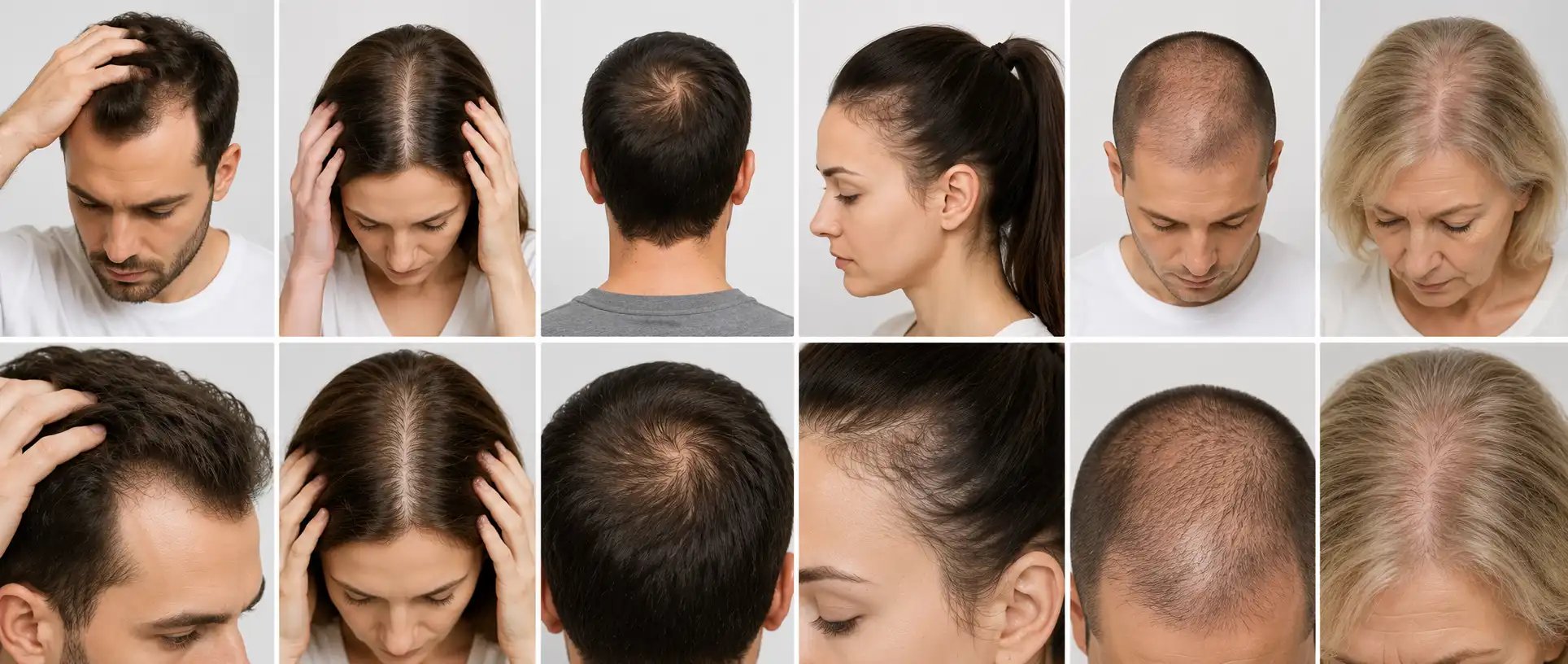
Hair loss doesn't look the same for everyone. Recognising the pattern often points to the cause.
Male pattern baldness
The most common type, male pattern baldness, follows a recognisable course: a receding hairline at the temples and thinning at the crown, while the hair around the back and sides is usually spared. It's driven by the genetic and hormonal process described earlier and tends to progress gradually over many years.
Patchy hair loss
Distinct, coin-sized round or oval patches of loss, with otherwise normal-looking skin, are the hallmark of alopecia areata. Sometimes short, tapered "exclamation mark" hairs are visible at the edge of a patch. This pattern is quite different from the gradual thinning of male pattern baldness.
Diffuse thinning
Some hair loss spreads evenly across the whole scalp rather than following a pattern or forming patches. This diffuse thinning reduces overall hair density without a clear bald spot. It can reflect the early stages of male pattern hair loss, where miniaturisation thins hairs across the top of the scalp before any obvious recession. It can also be a sign of telogen effluvium, covered next, so the timing and any recent triggers help tell them apart.
Telogen effluvium
Telogen effluvium is a diffuse, temporary shedding that appears around three months after a trigger such as illness, stress, surgery or a major dietary change. Rather than bald patches, it shows up as a general increase in shedding and a loss of overall volume. It's usually self-limiting, with the hair recovering over several months once the underlying cause resolves.
Traction alopecia
Traction alopecia is caused by constant pulling on the hair, usually from tight hairstyles [18]. Tight ponytails, buns, braids and hair extensions, and the weight of very long hair, can all put sustained tension on the follicles, often where the hair meets the edges of the head. Early on, the hair can recover fully if the tension stops, but long-term pulling can damage the follicles and cause permanent hair loss. The main step is to ease off tight styles before that happens.
When to seek medical advice
Most hair loss isn't dangerous, but some situations are worth getting checked, and early treatment gives the best chance of a good result where treatment can help. See a GP if you're worried about your hair loss or if it's affecting your wellbeing, and get an idea of the cause before spending money at a commercial hair clinic.
It's worth seeking advice sooner if the hair loss is sudden or patchy, if your scalp is red, scaly, itchy or sore, or if hair loss comes alongside other symptoms such as unexplained weight loss. A scarred or persistently inflamed scalp can point to an underlying condition that needs specific treatment.
For alopecia areata, specialist assessment may be appropriate when the diagnosis is uncertain, when there is extensive or rapidly progressive hair loss, or when specialist treatment is being considered. More generally, a doctor or pharmacist can help identify the cause and talk through whether treatment is appropriate.
Options for managing hair loss
The right treatment depends on the cause, and not all treatments suit every person. Temporary hair loss, such as telogen effluvium or shedding from a medicine or illness, often needs no treatment at all and recovers once the trigger passes.
For male pattern baldness, the two main medicines used are finasteride and minoxidil, and our hair loss treatment pages explain both in more detail. Finasteride is a tablet that lowers DHT, the hormone behind pattern hair loss, and may slow loss and support some regrowth. Sexual side effects, including reduced libido, have been reported in a small proportion of men. It's also sold under the brand name Propecia. Minoxidil is applied to the scalp and can help promote growth. Both treatments have limitations: they don't work for everyone, and their benefits generally need to be maintained with continued use.
Finasteride 1 mg is licensed for male pattern hair loss and is not indicated for use in women. Female pattern hair loss has different clinical features and treatment considerations, so women with hair loss should seek an assessment to determine the most appropriate treatment.
Other approaches, from wigs and cosmetic camouflage to procedures like hair transplantation, exist for different needs and are worth discussing with a professional. For any treatment, a proper assessment of the cause comes first.
Frequently asked questions about hair loss
Why is hair loss more common in men?
Male pattern baldness is androgen-dependent, meaning it's driven by the hormone DHT acting on genetically sensitive follicles. Male pattern hair loss is more common in men because of differences in androgen exposure and genetically determined follicular sensitivity. It can also develop earlier in men than in women.
At what age does hair loss usually begin in men?
It can start any time after puberty. Male pattern baldness becomes more common with age: one study found moderate to extensive loss in 16% of men in their late twenties, rising to 53% by the forties. An earlier age of onset is associated with a greater likelihood of more extensive hair loss over time, although progression varies between individuals.
Can a vitamin deficiency cause you to lose hair?
Certain nutritional deficiencies, including iron, zinc or vitamin D deficiency, have been associated with some forms of hair loss, although the evidence varies. Supplements are unlikely to help if you are not deficient. If you suspect a deficiency, it's worth getting tested rather than guessing.
Does hair grow back after hair loss?
Whether hair grows back after hair loss depends on the cause. Temporary types like telogen effluvium, and hair loss from scalp ringworm once treated, usually recover. Alopecia areata often regrows on its own, though further episodes are common. Male pattern hair loss is progressive and does not usually reverse spontaneously, although treatments can slow further loss and promote or maintain some regrowth. Long-standing traction alopecia can be permanent once the follicles are damaged.
Can a crash diet trigger hair loss?
Yes. Rapid weight loss and severe calorie restriction can push follicles into the shedding phase, causing a temporary telogen effluvium a few months later. The hair typically regrows once you're eating adequately again. A more gradual approach to weight loss may reduce the risk of hair shedding associated with rapid weight loss and severe calorie restriction.
When should medical advice be sought?
See a GP if you're worried, if hair loss is sudden or patchy, if your scalp is red, sore or scaly, or if it comes with other symptoms such as weight loss. Getting the cause identified early helps, especially before paying for commercial treatments.
-
1. Murphrey MB, Agarwal S, Zito PM. Anatomy, hair. In: StatPearls. StatPearls Publishing; updated August 14, 2023. https://www.ncbi.nlm.nih.gov/books/NBK513312/
2. NHS. Hair loss. Last reviewed: 24 January 2024. https://www.nhs.uk/symptoms/hair-loss/
3. Malkud S. Telogen effluvium: a review. J Clin Diagn Res. 2015;9(9):WE01-WE03. doi:10.7860/JCDR/2015/15219.6492
4. Kidangazhiathmana A, Santhosh P. Pathogenesis of androgenetic alopecia. Clin Dermatol Rev. 2022;6(2):69-74. doi:10.4103/cdr.cdr_29_21
5. British Association of Dermatologists. Male pattern hair loss (androgenetic alopecia). Patient information leaflet. https://cdn.bad.org.uk/uploads/2021/11/19091654/Hair-loss-male-pattern-PIL-June-2024.pdf
6. Trost LB, Bergfeld WF, Calogeras E. The diagnosis and treatment of iron deficiency and its potential relationship to hair loss. J Am Acad Dermatol. 2006;54(5):824-844. doi:10.1016/j.jaad.2005.11.1103
7. Wang R, Lin J, Liu Q, et al. Micronutrients and androgenetic alopecia: a systematic review. Mol Nutr Food Res. 2024. doi:10.1002/mnfr.202400652
8. British Association of Dermatologists. Telogen effluvium. Patient information leaflet; October 2025. https://www.bad.org.uk/pils/telogen-effluvium/
9. Tosti A, Misciali C, Piraccini BM, Peluso AM, Bardazzi F. Drug-induced hair loss and hair growth: incidence, management and avoidance. Drug Saf. 1994;10(4):310-317. doi:10.2165/00002018-199410040-00005
10. Hussein RS, Atia T, Bin Dayel S. Impact of thyroid dysfunction on hair disorders. Cureus. 2023;15(9):e43266. doi:10.7759/cureus.43266
11. National Institute for Health and Care Excellence. Alopecia areata. Clinical Knowledge Summaries; revised September 2024. https://cks.nice.org.uk/topics/alopecia-areata/
12. British Association of Dermatologists. Alopecia areata. Patient information leaflet; April 2024. https://www.bad.org.uk/pils/alopecia-areata/
13. Barbosa V, Hight R, Grullon K. Scalp infection, inflammation, and infestation. Dermatol Clin. 2023;41(3):539-545. doi:10.1016/j.det.2023.02.008
14. NHS. Ringworm. https://www.nhs.uk/conditions/ringworm/
15. Su LH, Chen TH. Association of androgenetic alopecia with smoking and its prevalence among Asian men: a community-based survey. Arch Dermatol. 2007;143(11):1401-1406. doi:10.1001/archderm.143.11.1401
16. Goette DK, Odom RB. Alopecia in crash dieters. JAMA. 1976;235(24):2622-2623. https://pubmed.ncbi.nlm.nih.gov/946869/
17. Rhodes T, Girman CJ, Savin RC, et al. Prevalence of male pattern hair loss in 18-49 year old men. Dermatol Surg. 1998;24(12):1330-1332. doi:10.1111/j.1524-4725.1998.tb00009.x
18. British Association of Dermatologists. Traction alopecia. Patient information leaflet; February 2019. https://www.bad.org.uk/pils/traction-alopecia/


